Record and assess
Describe the deviation, affected process, immediate correction and available evidence while the facts are current.
Deviation investigations and corrective action management
Manage pharmaceutical quality deviations, investigate root causes and track corrective and preventive actions in one structured system. CAPA Manager helps quality teams maintain clear ownership, investigation history and effectiveness follow up.
Free for 2 users and up to 5 new investigations per month. No credit card. No sales call. No fixed trial expiration.

A proportionate investigation process
Manufacturing process deviations, batch processing discrepancies, equipment related quality issues, documentation errors, supplier problems, recurring nonconformances and audit findings all require a clear investigation history and accountable follow up.
Not every deviation automatically requires a formal CAPA. The organization's established procedures should determine the appropriate response based on factors such as significance, recurrence, risk and applicable requirements.
Deviation → Assessment → Investigation → Root Cause → CAPA → Verification → Effectiveness → Closure
Record and assess
Describe the deviation, affected process, immediate correction and available evidence while the facts are current.
Investigate the cause
Assign ownership and document potential causes, contributing factors, evidence and the team's conclusions.
Manage CAPA actions
Set action owners and target dates, then retain implementation records with the original investigation.
Verify and close
Review implementation and effectiveness before recording the organization's closure decision.
CAPA Manager supports the documentation and management of corrective action activities within a pharmaceutical quality system. Teams can maintain investigation records, assign responsibilities, record root cause analysis, manage action plans and retain implementation, review and closure history.
ICH Q10 Pharmaceutical Quality System includes CAPA as a pharmaceutical quality system element and emphasizes a structured, proportionate investigation process and evaluation of action effectiveness.
CAPA Manager supports structured GMP quality processes. Customers remain responsible for their procedures, risk assessments, training, intended use validation and regulatory conformity.
Structured pharmaceutical investigations
Immediate correction restores control of the current issue. Root cause investigation examines why the problem occurred and what should change to reduce recurrence. CAPA Manager helps teams document their investigation and evidence without claiming to identify or validate the correct cause for them.
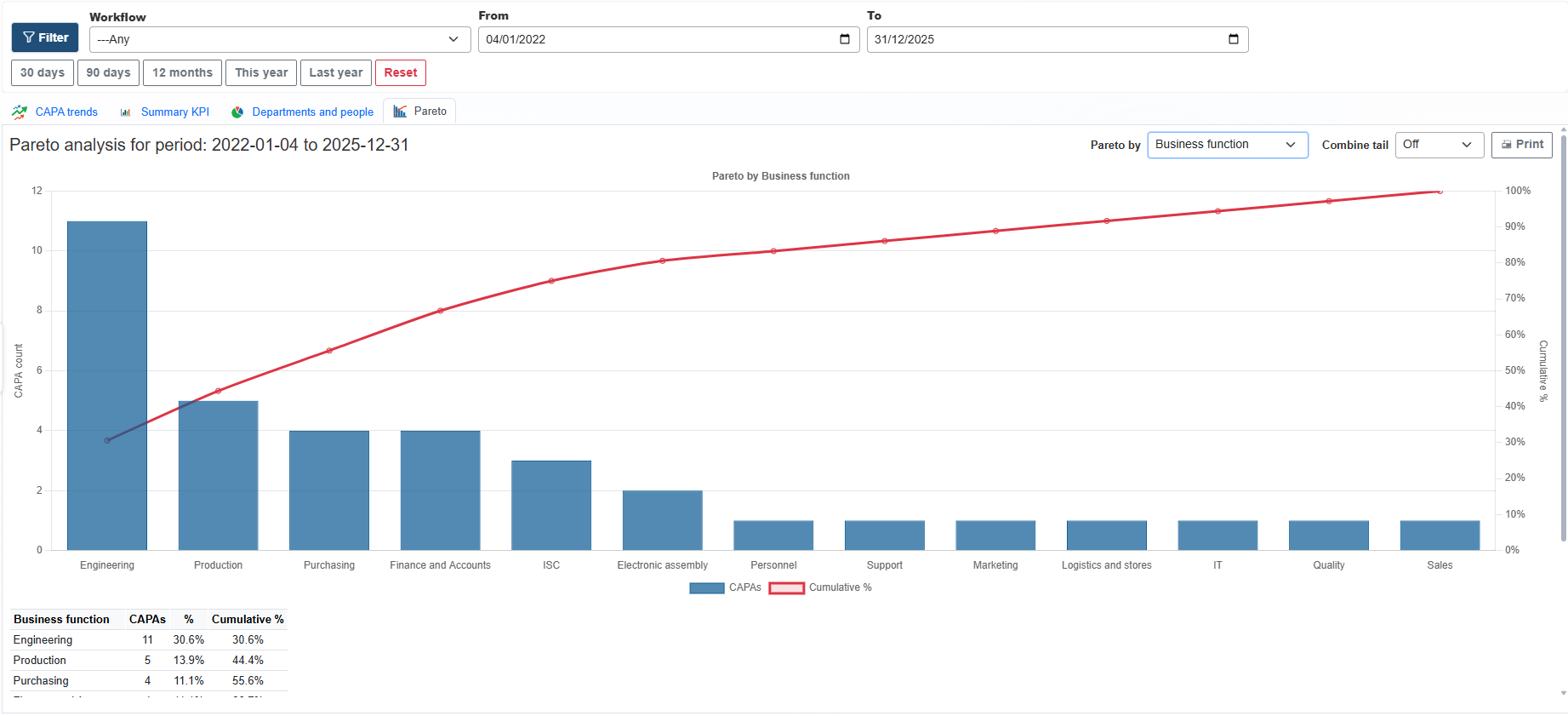
Use 5 Whys, Ishikawa or 6M analysis, Pareto analysis, structured CAPA investigations and 8D where these methods fit the organization's approved process.
Explore the specialist 8D investigation software page for the complete 8D workflow.
Connect the investigation to the corrective and preventive actions that follow. CAPA Manager helps quality teams assign action owners, set target dates, monitor implementation, record decisions and approvals, and follow up on outstanding work.
CAPA Manager is a CAPA and investigation management application. It does not replace pharmaceutical batch records, laboratory systems, batch release decisions or manufacturing execution systems.
Completing a corrective action is different from demonstrating that it was effective. CAPA Manager helps pharmaceutical quality teams retain a clear record of the original deviation, investigation, corrective action and subsequent effectiveness review.
If the evidence does not demonstrate the intended result, the organization can decide whether additional investigation, revised action or continued monitoring is required.
Start with 2 users and up to 5 new investigations per month. No credit card, no sales call and no fixed trial expiration. Premium accounts have no monthly CAPA or investigation limit.
These examples show how quality teams can apply structured investigation and corrective action management. CAPA Manager does not automatically determine product disposition, batch release or regulatory reporting obligations.
Manufacturing deviation
A production process operates outside its approved procedure. The team investigates contributing factors and manages appropriate corrective actions.
Recurring documentation errors
Repeated discrepancies trigger an investigation into training, procedures or process design.
Supplier quality issue
A supplier related defect requires internal investigation, ownership, follow up and effectiveness assessment.
Audit observation
An internal or external audit identifies a quality system weakness requiring documented investigation and corrective action.
Equipment related issue
Repeated equipment problems lead to a structured investigation and assigned improvement actions.
For audit specific workflows, explore audit corrective action software.
Maintain visibility from the original quality problem through investigation, action assignments, effectiveness review and closure.
Original deviation
Keep the issue, source, classification, affected process and immediate response visible.
Investigation findings
Connect ownership, evidence, root cause conclusions and the reasoning behind the selected response.
Actions and reviews
Retain target dates, progress, approvals, effectiveness results and closure decisions in the working history.
Premium evidence and reports
Attachments, supporting evidence uploads, PDF reports and data exports require an eligible Premium plan.
Where configured, named closure approvals and electronic sign-off are retained with the investigation history. Customers remain responsible for assessing intended use, validation and any applicable electronic record or signature requirements.
Quality managers need a practical view of open investigations, overdue corrective actions, responsible owners, closure progress and effectiveness follow up.
Owners and due dates
Assign responsibilities and target dates so the next action remains visible.
Investigation status
See the current workflow stage and the work still required before review.
Overdue actions
Keep delayed corrective actions visible to responsible users and quality managers.
Effectiveness follow up
Track whether an effectiveness review is planned, completed and documented.
Dashboards and trends
Review open, closed and overdue CAPAs, recurring causes and closure performance.
Configurable workflows
Use established workflows with configurable fields and classifications. Premium accounts can also use released customer designed workflows.
Review the CAPA Manager feature reference or compare Free and Premium pricing.
A dedicated CAPA application can provide structure without requiring a team to introduce a broad pharmaceutical eQMS at the same time. Begin with established workflows, then add users or Premium capabilities as requirements grow.
Structured workflows
Use established investigation and corrective action workflows with configurable fields and classifications.
Cloud access
Give authorized quality team members access to the same current investigation and CAPA records from supported web browsers.
Practical reporting
Monitor open work and trends, with additional reports, attachments and exports available on eligible Premium plans.
Flexible account sizes
Start with two free users, then review Premium options when more users or additional capabilities are needed.
Spreadsheets remain useful for many quality tasks. They become harder to manage when an investigation involves several owners, changing dates, approvals, evidence and effectiveness follow up.
CAPA Manager provides a shared corrective action record when multiple file versions, email only decisions and manual status reporting make progress difficult to see.
What is pharmaceutical CAPA software?
Pharmaceutical CAPA software helps quality teams document deviations, investigate causes, assign corrective and preventive actions, review implementation and record effectiveness and closure history.
How can CAPA Manager support GMP quality processes?
CAPA Manager supports structured investigation, action ownership, implementation tracking, reviews and effectiveness records. The organization remains responsible for its pharmaceutical quality system, validation and regulatory conformity.
Can CAPA Manager help manage pharmaceutical deviation investigations?
Yes. Teams can document the deviation, assessment, investigation findings, root cause conclusions and resulting actions where their approved procedures require them.
Does every pharmaceutical deviation require a CAPA?
No. The response should follow the organization's procedures and consider factors such as significance, recurrence, risk and applicable requirements.
How does CAPA Manager support root cause investigations?
Teams can use structured workflows and tools such as 5 Whys, Ishikawa or 6M analysis and Pareto analysis to document potential causes, evidence and conclusions.
How can pharmaceutical CAPA effectiveness be verified?
Define the intended result, select an appropriate follow up interval, review implementation and recurrence evidence, then record whether the corrective action achieved that result.
Can CAPA Manager help track audit corrective actions?
Yes. Teams can record findings, assign owners and dates, document investigation and action, and retain review and effectiveness history.
Can pharmaceutical quality teams start with a free account?
Yes. CAPA Manager offers a free account for two users and up to 5 new investigations per month, with no credit card and no fixed trial expiration. Premium accounts have no monthly CAPA or investigation limit. Free accounts remain subject to the applicable service terms and inactivity policy.
Professional CAPA software with a free two user starting point and up to 5 new investigations per month. Premium accounts have no monthly CAPA or investigation limit.